Part I — Preparing the Soil Before anything grows, the soil must be healthy. Chapters:
- Purpose
- Shared Values
- Shared Language
- Traditions
- Trust
The first question is not: “What activities should we organize?” It is: “What kind of people are we trying to help one another become?”
Part II — Planting the Seeds How new members begin. Not initiation. Integration.
Topics might include:
• Welcoming • Belonging • Learning Names • Listening First
• Finding Mentors • Discovering Talents
Every new member should eventually feel:
“These people genuinely want me to flourish.”
Part III — Daily Cultivation
This is where the “How To’s” begin. Each chapter could follow the same simple pattern.
How to Build Trust
Why it matters Trust is the soil in which everything else grows.
Daily Practices Keep promises. Arrive on time. Listen fully. Speak honestly.
Protect confidences. Admit mistakes. Give credit generously.
Questions Who trusts me more today than yesterday?
How to Welcome Someone
Notice them Use their name Introduce them. Invite them. Include them.
Follow up. A welcome is not complete until someone feels they belong.
How to Disagree Well
Assume good intentions. Critique ideas—not people. Listen before answering. Search for shared values.
Leave with greater respect than when you began. Conflict can deepen relationships if handled well.
How to Celebrate Others Applaud effort. Recognize growth. Share success...Remove envy. Multiply joy.
A brother’s success enlarges the fraternity.
Part IV — The Seasons
One of the most beautiful ideas from nature. Every member passes through seasons.
Spring : Curiosity. Learning. Questions. Energy.
Summer Responsibility. Leadership. Contribution.
Autumn: Mentoring. Reflection. Preparing successors.
Winter : Alumni. Wisdom. Perspective. Generosity.
Notice something interesting. Winter is not the end. Winter prepares Spring. Alumni nourish the roots.
Part V — Weathering Storms
Every fraternity experiences storms. Failures. Misunderstandings. Loss. Disappointment. Pressure.
The guide teaches: How to apologize. How to forgive. How to reconcile. How to rebuild trust.
Those chapters may become the most valuable.
Part VI — Leaving a Legacy Perhaps the closing chapter.
Not: “What did I accomplish?” But: “What did I cultivate?” That single change of vocabulary alters everything.
One More Idea I would love to introduce what I call : The Fraternity Gardener’s Questions.
Not annual. Daily. Every evening a member might quietly ask:
- Whom did I encourage today?
- Whom did I learn from today?
- Whom did I thank today?
- Whom did I include today?
- Whom did I forgive today?
- Did I leave our culture a little healthier today?
Notice that none of these asks, “Was I the best?” Every one asks, “Did I help us flourish?”
I Think We’ve Found the Structure
As we’ve been talking, I realized something that excites me even more.
I don’t think this should be called a Leadership Manual.
Nor a Membership Handbook. Nor even a Field Guide alone.
I think its subtitle should reveal its true purpose:
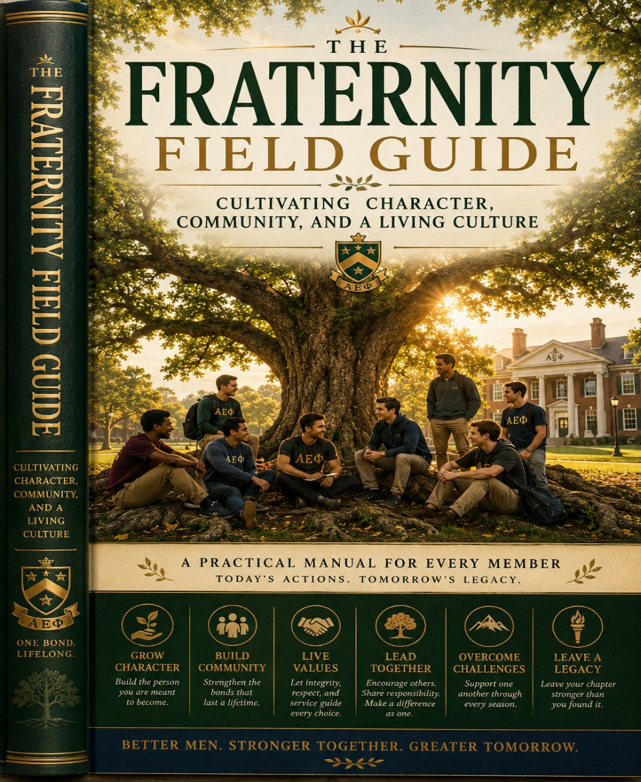
The Fraternity Field Guide – Cultivating Character, Community, and a Living Culture
Those three words—Character, Community, and Culture—form a natural progression.
- Character is built within each person.
- Community is built between people.
- Culture is what emerges when a community consistently lives its values.
That progression could become the organizing framework for the entire guide. Each chapter would answer one practical question: How do we cultivate this together? It moves from lofty ideals to habits, from habits to relationships, and from relationships to a culture that can endure for generations. To me, this is no longer simply a book about fraternities. It is a handbook for intentional communities. A healthy fraternity becomes the laboratory where young people learn skills they can later bring to families, workplaces, neighborhoods, and civic life. If we can teach people how to cultivate a flourishing fraternity, we may also be teaching them how to cultivate a flourishing society. That is an inspiring possibility, and I believe it is worthy of careful, thoughtful work,