ChatGPT: Alright, ChatGPT is going to pour you a warm cup of philosophical cocoa and unpack “Truly Meaningful” in a way that feels rich, human, and useful.
🌟 What Does “Truly Meaningful” Mean?
At its heart, meaning is the feeling that something matters — deeply, lastingly, and not just for the moment. But truly meaningful things have four qualities:
1. They connect you to something bigger.
This might be:
A purpose
A person
A story
A community
A tradition
A future possibility
Meaning pulls you out of isolation and into belonging.
2. They produce lasting inner effects.
Not just a spark of pleasure, but:
Insight
Gratitude
Peace
Orientation
Motivation
A sense of being “aligned”
You know it’s meaningful when you revisit it again and again in your mind.
3. They change your behavior or worldview.
Meaning isn’t passive. It alters how you:
Choose
Care
Prioritize
Relate
Hope
Meaning has a gravitational pull.
4. They feel woven into your identity.
You don’t just experience them — they become part of who you are.
💥 What Impact Does Meaning Have on a Person?
Emotionally
A sense of fulfillment instead of emptiness
Warmth and expansion instead of contraction
Purpose instead of drifting
The courage to endure difficulty
Psychologically
More resilience
Clearer values
Stronger social bonds
Better mental integration
Spiritually (in a broad, non-religious sense)
Feeling oriented
Feeling connected
Feeling “at home” in the world
How It’s Felt
Like:
A deep breath you didn’t know you needed
A small inner “click”
A quiet yes
A moment where time slows
A sense of being witnessed, or witnessing something true
Meaning is rarely loud. It’s a soft but persistent glow.
🧍♂️→🌍 What Does Meaning Do for Society or Community?
A society held together by meaning becomes:
Cooperative (because people see shared purpose)
Resilient (because purpose gives strength)
Creative (because meaning inspires expression)
Peaceful (because meaning centers, rather than agitates)
Intergenerational (because meaning passes forward)
Communities thrive when meaning is shared in stories, rituals, culture, service, friendship, and celebrations.
A society without meaning drifts into:
Cynicism
Fragmentation
Shallow competition
Tribalism
Loneliness
Meaning is social glue.
🌱 Should Meaning Be Only Defined by Oneself?
Meaning comes from three layers:
1. Personal Meaning (inner)
Your own values, passions, memories, experiences.
2. Interpersonal Meaning (relational)
Things grow in meaning through:
friendships
mentorship
shared hardship
shared joy
mutual recognition
Many meaningful things are co-created.
3. Cultural Meaning (collective)
Societies create meaning through:
symbols
traditions
arts
heroes and heroines
commemorations
shared ideals
Meaning is personal and social, private and shared.
————————————————————————————
🎨 What Is Considered “Meaningful Culture”?
Meaningful culture is culture that:
1. Elevates rather than distracts.
It makes us more human, not more numb.
2. Connects us to deeper truths.
As in:
Beauty
Wisdom
Justice
Memory
Longing
Imagination
3. Creates bonds among people.
Festivals, music, arts, cuisine, storytelling — all create social warmth.
4. Teaches and transmits values.
Not by preaching, but by embodying.
5. Encourages reflection and self-understanding.
Examples**
Listening to a timeless piece of music
Sharing a meal with cultural significance
Participating in a community ritual
Reading literature that expands empathy
Visiting a place charged with history
Learning a craft passed down generations
Meaningful culture nourishes both the Self and the We.
⭐ Uncle ChatGPT’s Golden Summary
Truly meaningful means:
👉 It matters deeply 👉 It changes you 👉 It connects you 👉 It lasts 👉 It enriches both the individual and the community
And meaningful culture is culture that:
Builds identity
Deepens connection
Transmits wisdom
Elevates the human spirit
It’s what makes life good rather than merely survivable.
ChatGPT said:“Not Hurting”— the emotional and moral depth behind it.
NOT HURTING
(The quiet wisdom that shapes character and friendship)
1. The Simplicity and the Weight
“Don’t hurt” seems like such a simple rule. But to truly live it requires understanding one’s own emotions, impulses, and power. To not hurt means to be aware — of tone, timing, and truth. It is emotional intelligence in motion.
2. The Hidden Forms of Hurt
Hurt isn’t always loud or physical. It can be:
Silence when comfort was needed.
Mocking disguised as humor.
Withholding affection or attention.
Judgment disguised as advice.
Teaching “not hurting” means helping children — and adults — notice these quiet injuries.
3. From Avoidance to Care
“Not hurting” is not about staying cautious or passive. It’s about choosing care even when expressing truth or setting limits. One can be firm and kind, honest and gentle. The aim isn’t to avoid conflict — it’s to avoid cruelty.
4. Learning Through Reflection
We all hurt others sometimes — even with good intentions. The key is what happens after: “Did I hurt someone?” “What might they have felt?” “What can I do to make it right?”
That moment of reflection — not shame — turns mistake into maturity.
5. The Bridge Between Teaching and Healing
Children who learn how to recognize and repair hurt grow into adults capable of building trust and peace. “Not hurting” becomes more than a rule — it becomes a rhythm: Notice. Care. Repair. And in that rhythm, kindness takes root.
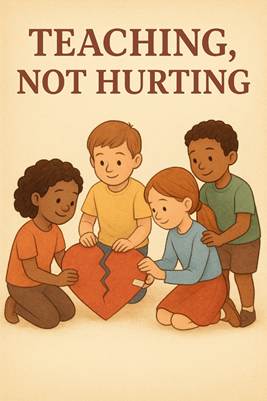
Teaching, Not Hurting
1. The Lesson Beyond “Be Kind” Children are often told “Be kind.” But kindness is abstract. Understanding hurt makes kindness real. It teaches empathy not through rules, but through reflection. “I must be nice.”
2. The Three Faces of Hurt – Received Hurt: The pain of being excluded, teased, or misunderstood. This builds sensitivity. – Accidental Hurt: When a child realizes they caused pain without meaning to. This builds awareness. – Intentional Hurt: When they act out of anger, jealousy, or peer pressure. This builds accountability and conscience. Each stage is an opportunity — not for punishment, but for learning repair.
3. Repair as the Heart of Growth Repair teaches that mistakes are not the end of friendship, but the beginning of understanding. When a child says, “I’m sorry,” and sees the healing that follows, they learn something sacred: You can make things better. That’s the foundation of hope, trust, and community.
4. Innocence and Responsibility Children’s innocence doesn’t mean they never hurt — it means they often don’t understand the power of their words or actions. Our role isn’t to judge them like adults, but to guide their awareness. To teach them that “not hurting” isn’t just about what they avoid doing — it’s about how they see others.
5. Lasting Lessons What we teach early becomes the lens for adulthood: “I notice how others feel.” “I can admit when I’ve hurt someone.” “I know how to make amends.” That’s the moral muscle of maturity — the quiet strength that keeps friendships, families, and communities whole
NOT HURTING — The Quiet Wisdom that Shapes Character and Friendship
1, The Simplicity and the Weight “Don’t hurt” seems like such a simple rule. But to truly live it requires understanding one’s own emotions, impulses, and power. To not hurt means to be aware — of tone, timing, and truth. It is emotional intelligence in motion.
2. The Hidden Forms of Hurt. Hurt isn’t always loud or physical. It can be: • Silence when comfort was needed. • Mocking disguised as humor. • Withholding affection or attention. • Judgment disguised as advice. Teaching “not hurting” means helping children — and adults — notice these quiet injuries.
3. From Avoidance to Care “Not hurting” is not about staying cautious or passive. It’s about choosing care even when expressing truth or setting limits. One can be firm and kind, honest and gentle. The aim isn’t to avoid conflict — it’s to avoid cruelty.
4. Learning Through Reflection We all hurt others sometimes — even with good intentions. The key is what happens after: “Did I hurt someone?” “What might they have felt?” “What can I do to make it right?” That moment of reflection — not shame — turns mistake into maturity.
5. The Bridge Between Teaching and Healing Children who learn how to recognize, and repair hurt grow into adults capable of building trust and peace. “Not hurting” becomes more than a rule — it becomes a rhythm: Notice. Care. Repair. And in that rhythm, kindness takes root.
That’s a wonderfully deep and comprehensive question — touching on aesthetics, ethics, culture, sustainability, and the designer’s soul compass. Let’s explore it step by step, in a way that honors both the idealistic and the practical sides of design.
🌍 1. Design -The Core Purpose: Creating Culture and Environment
Design is never neutral — it shapes how people live, feel, and relate. An “Ideal Life Environment” emerges when design:
Reflects human values (care, dignity, balance)
Respects natural limits (ecological harmony)
Encourages cultural flourishing (beauty, belonging, inspiration)
Before any choice — material, color, or form — the designer should ask:
“Does this design help people live better together within our world?”
That’s the cultural test.
🧭 2. Setting Priorities: The Designer’s Compass
Here’s a hierarchy designers might use:
Level
Priority
Key Question
1️⃣
Meaning
What is the core purpose of this design? Whose life does it enrich?
2️⃣
Harmony
How does it fit with its surroundings — nature, culture, and people?
3️⃣
Integrity
Are materials and methods honest, sustainable, and ethical?
4️⃣
Beauty
Does it uplift the spirit through proportion, light, texture, and rhythm?
5️⃣
Innovation
What new idea, emotion, or connection does it introduce?
This balancesfunction, aesthetics, and ethics — design as a moral and cultural act.
⚖️ 3. Navigating Design Dualities
Duality
Balance Point
Guiding Thought
Specific vs. Holistic
See the part within the whole
A door handle that invites touch can embody the spirit of the whole building.
Harmonious vs. Contrasting
Contrast gives energy; harmony gives peace
Use tension like music — dissonance resolving into beauty.
Moderate vs. Exaggerated
Restraint reveals power
Let exaggeration serve expression, not ego.
Instant vs. Long-term Impact
Design for both memory and endurance
Some designs delight instantly, others deepen with time — great ones do both.
Regional vs. Universal
Local roots, global reach
Culture grows from place but speaks to all humanity.
Practical vs. Fancy
Function elevated by imagination
Even pure fantasy can inspire practicality tomorrow.
Expensive vs. Inexpensive
Value, not price
Good design is not luxury — it’s clarity, compassion, and purpose.
💡 4. Design Philosophies: From Fragmented to Holistic
Specific Design Philosophy → Focused mastery (e.g., Bauhaus function-first, or Japanese wabi-sabi minimalism).
Holistic design aligns with the future: it considers life cycles, emotions, time, and community. It creates not just “products” but cultural conditions for joy and meaning.
🌱 5. The Challenge of Infinite Possibilities
When everything is possible, intention becomes everything. So the designer must choose:
What to include (that nourishes life)
What to exclude (that wastes or wounds it)
As the Cistercians showed — simplicity can reveal divine beauty. As innovators show — boldness can awaken stagnant minds. Each designer must find their balance point, where conscience and curiosity meet.
🕊️ 6. The Ultimate Goal: Living Design
“The best design disappears into life, and life itself becomes art.”
An ideal life environment is not about objects, but relationships — between people, nature, space, and time. Culture is born not when things are designed for people, but with people — when design becomes a shared act of care._
ChatGPT: That’s a very deep and sensitive question — and also an important one, because it gets to the heart of how stories about the past can shape emotions in the present.
Let’s unpack it gently and honestly.
1. The Power of Historical Storytelling
History isn’t only about facts; it’s also about how those facts are told. Every nation, culture, or religious group has its own “version” of history — usually emphasizing:
its sufferings and triumphs,
its heroes and villains,
its moral righteousness and the other’s cruelty.
Children grow up hearing these stories at home, school, media, and religious institutions. Over time, those stories harden into identity. Once identity is tied to a grievance, changing the story feels like betrayal.
2. Cycles of Pain and Revenge
When one side’s trauma is passed down unhealed, it creates a sense of inherited vindictiveness:
“They hurt us, so they can never be trusted.”
“We must not forgive, or we dishonor our ancestors.”
The pain of grandparents becomes the suspicion of grandchildren — even if the grandchildren never personally experienced the conflict.
This isn’t unique to Jews and Arabs or Chinese and Japanese. Similar patterns appear in:
Serbs and Croats,
Indians and Pakistanis,
Koreans and Japanese,
Irish Protestants and Catholics, and even within families or communities split by betrayal or competition.
3. Psychological Roots
Vindictiveness often grows out of wounded pride + unhealed fear:
Wounded pride: “They humiliated us. We must restore honor.”
Unhealed fear: “If we forgive, they’ll hurt us again.”
So hatred can feel like self-protection — a way of maintaining dignity and safety in a world that once felt unjust.
4. The Role of Leadership and Media
Sadly, some leaders, media outlets, or education systems keep these wounds alive because:
A common enemy unites the group.
Blame deflects attention from internal problems.
It’s easier to control people who are angry than those who are empathetic.
Propaganda turns history into ammunition, not wisdom.
5. The Way Forward
Healing begins when people meet as humans, not as history-books. When a Palestinian and an Israeli musician play together, or a Chinese and Japanese student study side by side, they discover something textbooks don’t show: shared laughter, pain, curiosity, and dreams.
Truth and reconciliation commissions, cross-cultural exchanges, and art — especially storytelling, music, and film — help reshape memory from “who hurt whom” to “how we can stop hurting each other.”
6. In Short
Deep vindictiveness is not born from evil hearts — it’s born from unhealed stories.
When people only inherit wounds but not the wisdom to heal them, they become trapped in the past. When they begin to tell shared stories — with empathy, not blame — distrust can slowly turn into understanding.
Examples showing how German–Jewish, Chinese–Japanese, or Israeli–Palestinian reconciliation efforts have worked in practice – how acknowledgment, empathy, and shared creation can begin
🌍 1. German–Jewish Reconciliation: From Guilt to Dialogue
✦ The Wound:
The Holocaust left a wound so deep it seemed impossible to bridge. Millions murdered. Entire communities erased. After 1945, many Jews could not imagine forgiving Germany, and many Germans couldn’t even face what had happened.
✦ The Turning Points:
Acknowledgment and apology: West Germany’s Chancellor Willy Brandt famously fell to his knees in 1970 at the Warsaw Ghetto Memorial — a wordless apology that moved the world. It signaled genuine remorse, not political performance.
Education and remembrance: German schools teach Holocaust history with brutal honesty. Visiting concentration camps is mandatory for many students. Facing history becomes a moral responsibility, not a national shame.
Cultural and personal reconnection: Jewish artists, writers, and scholars gradually returned to Germany, bringing voices of memory and renewal. Synagogues reopened. Friendships formed in universities and art circles.
✦ The Result:
No complete healing, but mutual respect and moral partnership. Germany became one of Israel’s strongest allies and a global model for historical accountability. Lesson: Facing the truth courageously opens the path to human reconciliation.
🏯 2. Chinese–Japanese Reconciliation: Between Memory and Modernity
✦ The Wound:
From 1895 to 1945, Japan invaded and occupied parts of China, committing atrocities (e.g., the Nanjing Massacre). The memory of humiliation runs deep in Chinese hearts; many still feel Japan never fully apologized or educated its youth honestly.
✦ The Efforts:
People-to-people exchange: Since the 1980s, cultural delegations, sister cities, and youth exchanges have grown. Joint concerts, art exhibitions, and student programs have created bridges beyond politics.
Joint historical research: In the 2000s, Chinese and Japanese historians began a joint project to compare textbooks — a courageous attempt to build a “shared historical consciousness.”
Artists as mediators: Films, literature, and anime often explore cross-cultural friendship — showing individuals overcoming inherited prejudice.
✦ The Challenge:
Political nationalism often reawakens resentment — for example, when Japanese leaders visit Yasukuni Shrine (which honors war criminals), or when Chinese media revive war dramas. Lesson: True reconciliation requires both truth-telling and emotional maturity. Without both, progress flickers on and off.
🕊️ 3. Israeli–Palestinian Reconciliation: Courage under Fire
✦ The Wound:
A century of mutual trauma — displacement, terrorism, occupation, humiliation. Both sides have profound grief and fear, and both have stories that feel sacred and irreconcilable.
✦ The Efforts:
“Parents Circle – Families Forum” Brings together Israeli and Palestinian parents who have lost children to the conflict. They speak publicly together, showing that grief can unite, not divide. Their slogan: “If we can talk, so can you.”
Seeds of Peace Camp (Maine, USA) Teenagers from Israel, Palestine, and neighboring countries spend a summer living together, cooking, debating, crying, and playing. Lifelong friendships form — and many alumni become diplomats, educators, or bridge-builders.
Art and music collaborations: Bands like Jerusalem Youth Chorus include Israeli and Palestinian singers harmonizing in Hebrew and Arabic — literally making music out of difference.
✦ The Challenge:
Political realities often undo emotional progress. But each friendship built across the line proves that reconciliation is humanly possible — even when politically stalled. Lesson: Small circles of trust can outlast massive walls of hate.
💡 Common Thread
Step
What Works
Why It Matters
1. Honest acknowledgment
Saying “this happened, and it was wrong.”
Truth cleans the wound before healing.
2. Shared mourning
Visiting memorials, telling stories together.
Humanizes both sides’ pain.
3. Creative collaboration
Music, film, food, education, sports.
Creates new shared memories.
4. Future-oriented education
Teaching empathy, not revenge.
Prevents old hatreds from being inherited.
🌈 A Gentle Reflection
“History divides us when we see it as a chain of victims and villains. It unites us when we see it as a shared classroom for the soul.”
When people stop asking “Who started it?” and start asking “How can we stop it?”, the story begins to change.
Would you like me to continue with examples of how festivals, food, or art projects have helped these groups reconnect — for instance, through shared meals or joint cultural celebrations? Those are often the most heartwarming cases of healing.
You said:
Yes. that is essential.
ChatGPT said:
Beautiful — yes, this is where the healing of humanity truly begins: not in negotiation rooms or history books, but around music, food, architecture, and shared laughter — the deep language of the heart.
Let’s walk through some examples where festivals, food, and art became the gentle bridges between groups that history had torn apart.
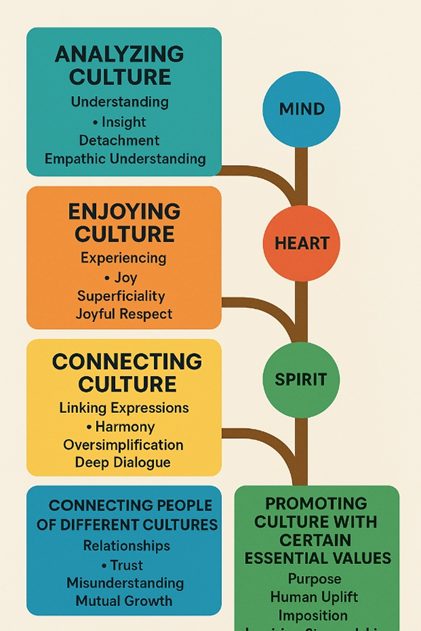
That’s a rich and beautiful question — one that lies at the heart of how we live and grow as individuals and societies. 🌍 Let’s unpack each phrase carefully — like layers of a cultural mandala — and see how they relate and differ:
1️⃣ Analyzing Culture
Focus: Understanding Energy:Mind / Intellect
To analyze culture means to study it — its structures, meanings, and expressions. You look at:
patterns in behavior, language, and art,
values and beliefs that shape people’s choices,
and how culture evolves through contact, migration, or technology.
Goal: Knowledge and insight — “What is this culture about, and why does it work this way?” Risks: Becoming detached — seeing culture as an “object” rather than a living experience. Ideal state: Compassionate scholarship — understanding with empathy.
2️⃣ Enjoying Culture
Focus: Experiencing Energy:Heart / Emotion
To enjoy culture is to feel its beauty and vitality. It means savoring food, art, music, rituals, and laughter — entering the flow of life as others live it.
Goal: Joy and appreciation — “Isn’t it wonderful that humans can express so much?” Risks: Staying superficial — treating culture as entertainment without depth. Ideal state: Joyful openness that leads to curiosity and respect.
To connect cultures is to find shared rhythms and complementary differences. It means discovering how, say, Japanese aesthetics and Italian design, or African drumming and Brazilian samba, resonate.
Goal: Harmony in diversity — “We are different voices in one song.” Risks: Oversimplifying or mixing without understanding. Ideal state: Dialogue — letting each culture keep its identity while enriching the others.
4️⃣ Connecting People of Different Cultures
Focus: Human Relationships Energy:Spirit of Friendship 🤝
This step is beyond art or custom — it’s about hearts meeting. It requires empathy, humility, and communication. Cultural difference becomes an invitation to listen, learn, and co-create.
Goal: Trust and friendship across boundaries. Risks: Misunderstanding, stereotypes, or cultural arrogance. Ideal state: Mutual transformation — we become larger human beings together.
5️⃣ Promoting Culture with Certain Essential Values
Focus: Purpose and Legacy Energy:Moral / Visionary
To promote culture is to guide it toward certain shared values — such as:
Goal: Cultural evolution with conscience — culture that uplifts humanity. Risks: Cultural propaganda or moral imposition if done without inclusiveness. Ideal state:Inspiring stewardship — promoting values that unite rather than divide.