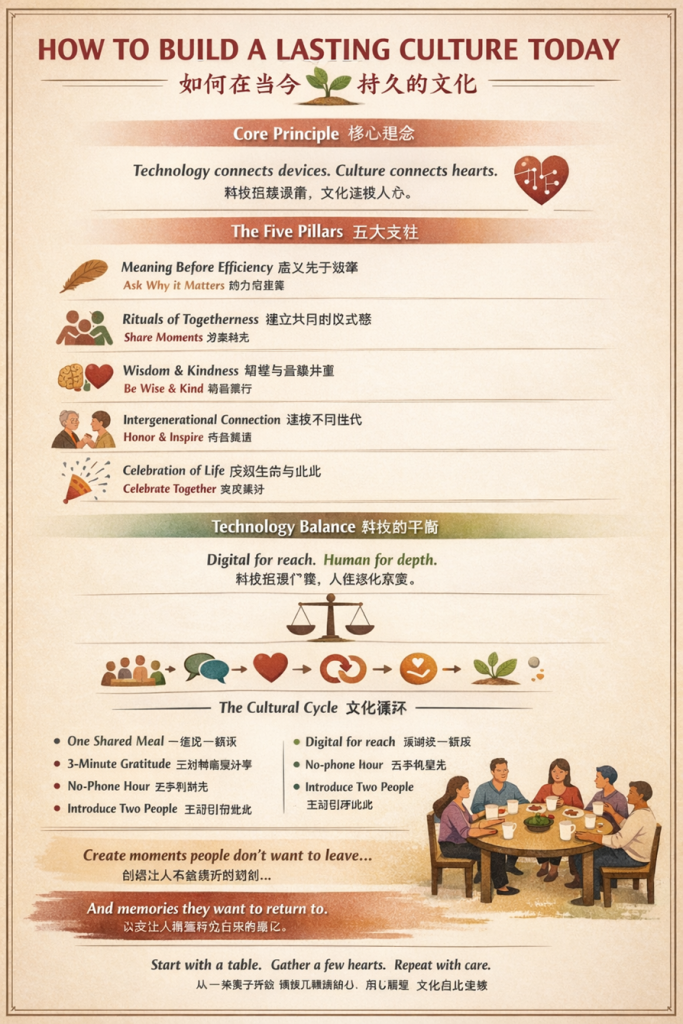
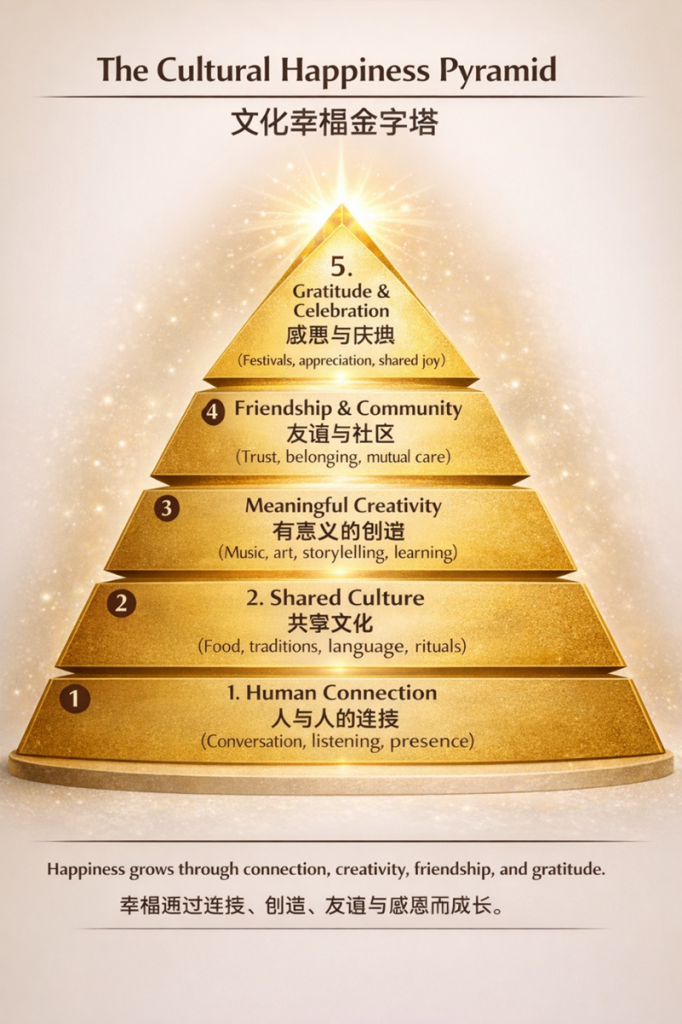
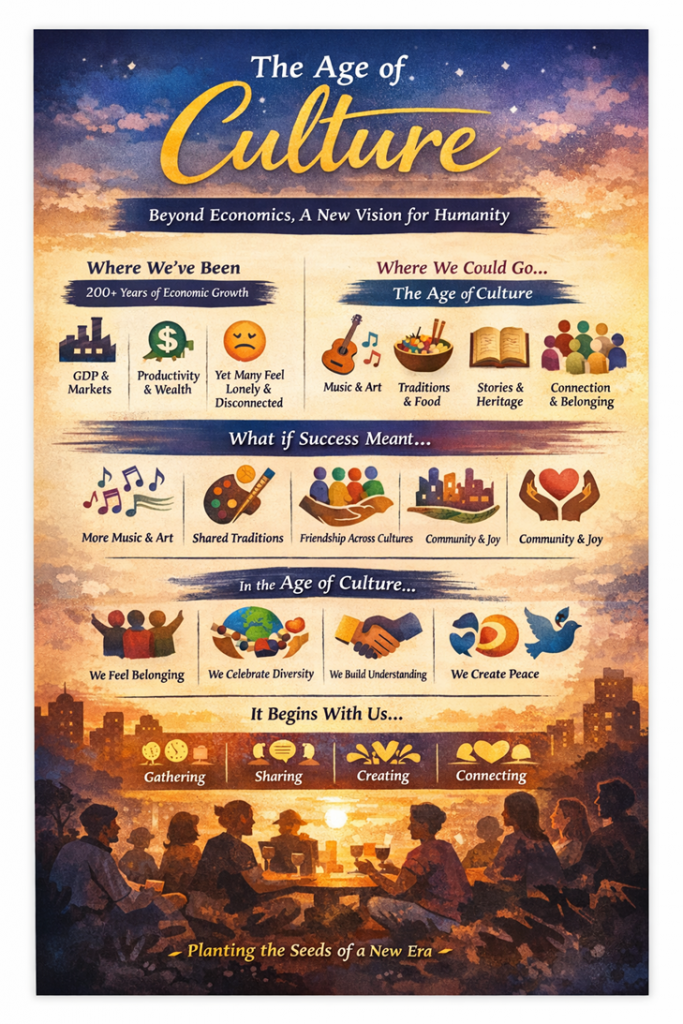
In Promoting The Age of Culture Globally, we need trained Program Directors and Facilitators. Are there schools teaching this special Discipline like Hotel Management and Tour Guides or Festival Directors ? Any good ideas to advance this urgent need?-Billy – March 2026

ChatGPTWhat you’re sensing is absolutely right: we have schools for hotels, tourism, and events—but almost none explicitly designed to train “Cultural Program Directors” or “Age of Culture Facilitators.”

The good news? The building blocks already exist. The opportunity is to connect and elevate them into a new discipline.


🌍 1. What Already Exists

🎪 Event & Festival Management (closest match)

  • Programs like University of Central Florida Rosen College of Hospitality Management teach full lifecycle event design—planning, logistics, experience creation
  • Florida International University Chaplin School of Hospitality & Tourism Management even includes festival production, entertainment, and mega-events

👉 These train people to run events efficiently, but not necessarily to shape culture or meaning.

🎭 Arts & Cultural Management (deeper layer)

Found in universities (often under “Arts Administration” or “Cultural Management”):

  • Focus: museums, theater, public culture, funding, audiences
  • Goal: stewardship of culture

👉 These train people to preserve and manage culture, but lack often community activation skills.

🌐 Hospitality & Tourism (global coordination)

  • Programs combine people experience + place-based identity + storytelling
  • Strong in international coordination and service culture

👉 These train people to host culture, but not necessarily to create new cultural movements.

💡 Key Insight

None of these alone produce what you’re envisioning:

A facilitator of meaningful human connection, cultural dialogue, and shared happiness.

That is a new profession.

🌱 2. What’s Missing

👉 “Cultural Facilitation & Program Direction”

A new hybrid discipline combining:

Existing FieldWhat it contributes
Event ManagementExecution & logistics
Arts/Culture ManagementMeaning & heritage
PsychologyHuman connection
EducationFacilitation & learning
Community DevelopmentSocial cohesion

🧭 3. A New Role Definition

🌟 Cultural Program Director

  • Designs meaningful gatherings (not just events)
  • Creates shared emotional experiences
  • Builds long-term community bonds

🌟 Cultural Facilitator

  • Guides conversations (like salons, dialogues)
  • Encourages empathy, storytelling, reflection
  • Turns “people in a room” → “people in connection”

🏫 4. Your Big Opportunity: Create the First “School of Cultural Facilitation”

Here’s where it gets exciting…

🎓 Prototype Curriculum

1. Cultural Foundations

  • World cultures & traditions
  • Meaning, values, symbols

2. Human Connection Skills

  • Listening & empathy
  • Group dynamics
  • Conflict transformation

3. Experience Design

  • Rituals, ceremonies, storytelling
  • Designing “moments that matter”

4. Event & Program Craft

  • Logistics, budgeting, partnerships
  • Festival and gathering design

5. Facilitation Practice

  • Leading circles, salons, dialogues
  • Moderating diverse groups

6. Field Experience

  • Run real community programs
  • Work in cities, schools, cultural centers

🌍 5. Practical Ways to Start (Right Now)

🌱 Step 1: Create a “Certificate Program”

Start small:

  • “Certified Cultural Facilitator (CCF)”
  • 6–12 weeks
  • Hybrid (online + real-world practice

🏙️ Step 2: Partner with Cities

Offer to:

  • Train community leaders
  • Train library / cultural center staff
  • Train festival organizers

🎪 Step 3: Upgrade Existing Fields

Instead of replacing, enhance:

  • Event planners → “Meaningful Experience Designers”
  • Tour guides → “Cultural Storytellers”
  • Teachers → “Community Facilitators”

🤝 Step 4: Build a Global Network

  • “World Cultural Facilitators Guild”
  • Annual gathering (your own Festival of Culture)

💡 6. A Powerful Framing ( Spread It)

Instead of saying:    “We need more event planners…”

Say: “We need trained stewards of human connection.”

Or even simpler:   “Professionals of Togetherness.”

🌟 7. The Deeper Truth

Hotels manage comfort.
Tourism manages movement.
Events manage moments.

But what you’re pointing to is rarer:

Who is trained to Cultivate Meaning between people?

That’s the missing profession of our time.


🌍 Global Institute for Cultural Facilitation    – Curriculum and Syllabus

🎓 Program: Cultural Program Direction & Facilitation

Degree / Certification Options:

  • Certificate (12 weeks) → Practitioners
  • Diploma (6–9 months) → Program leaders
  • Master-level (1–2 years) → Cultural Directors / Policy influ

🧭 Program Philosophy

“To cultivate professionals who can design meaningful human experiences, foster authentic connection, and build enduring cultures of shared happiness.”


🧱 CORE CURRICULUM STRUCTURE

🔹 MODULE 1: Foundations of Culture & Meaning

Course Title: Cultural Literacy and Human Meaning Systems

Objectives:

  • Understand culture as lived experience (not abstraction)
  • Explore values, rituals, symbols across civilizations
  • Distinguish economic success vs cultural richness

Topics:

  • What is culture? (beyond art)
  • Rituals, traditions, identity
  • Collective vs individual happiness
  • Case studies of enduring cultures

Assignment:

  • Map your own “Cultural Identity Landscape”

🔹 MODULE 2: Psychology of Human Connection

Course Title: The Science of Belonging and Emotional Resonance

Objectives:

  • Learn how trust, empathy, and connection form
  • Understand group dynamics and emotional contagion

Topics:

  • Belonging vs isolation
  • Listening as a cultural act
  • Emotional safety in groups
  • Intergenerational and cross-cultural empathy

Practice:

  • Guided listening circles
  • Paired storytelling

🔹 MODULE 3: Facilitation Mastery

Course Title: Dialogue, Presence, and Group Facilitation

Objectives:

  • Train facilitators to guide meaningful interactions
  • Learn to handle silence, tension, and diversity

Topics:

  • Circle facilitation
  • Asking powerful questions
  • Managing conflict with dignity
  • Holding space (presence over control)

Assessment:

  • Facilitate a 60-minute live session

🔹 MODULE 4: Experience & Ritual Design

Course Title: Designing Transformative Cultural Experiences

Objectives:

  • Move beyond events → create memorable, meaningful moments

Topics:

  • Rituals vs activities
  • Designing openings, peaks, closings
  • Symbolism and storytelling
  • Multi-sensory experience design

Project:  Design a “Festival of Gratitude” or “Friendship Salon”

🔹 MODULE 5: Program & Event Direction

Course Title: From Vision to Execution

Objectives:

  • Learn operational skills without losing meaning

Topics:

  • Program planning & logistics
  • Partnerships & sponsorships
  • Budgeting with values
  • Cultural sensitivity in global settings

Deliverable:

  • Full program blueprint (real-world ready)

🔹 MODULE 6: Community Building & Cultural Leadership

Course Title: Sustaining Living Cultures

Objectives:

  • Build long-term cultural ecosystems (not one-time events)

Topics:

  • Community formation stages
  • Leadership without dominance
  • Inclusion & diversity in practice
  • Scaling culture across cities

Case Study:

  • Design a “City Cultural Activation Plan”

🔹 MODULE 7: Ethics, Purpose & the Age of Culture

Course Title: From Economy to Meaning-Centered Societies

Objectives: Ground the work in purpose and responsibility

Topics:

  • Ethics of influence
  • Cultural dignity vs commercialization
  • Measuring “Cultural Value” (beyond money)
  • The Age of Culture framework

Reflection: Personal philosophy

🔹 MODULE 8: Practicum (THE HEART ) Course Title: Field Practice in Cultural Facilitation

Requirements:

  • Lead 3 real-world gatherings, such as:
    • Friendship Circles
    • Cultural Salons
    • Intergenerational dialogues

Evaluation Criteria:

  • Depth of connection created
  • Participant feedback
  • Reflection and growth

🧪 ASSESSMENT MODEL (VERY IMPORTANT) No exams. Instead:

✔ Portfolio-Based Evaluation Program designs / Facilitation recordings/ Reflection journals

✔ Live Demonstration Real facilitation session (observed)

✔ Community Impact Evidence of meaningful engagement


🏅 CERTIFICATION LEVELS

🌱 Level 1: Cultural Facilitatorm Can lead small group dialogues

🌿 Level 2: Cultural Program Designer Can design and run programs/events

🌳 Level 3: Cultural Director Can lead city-wide or institutional initiatives


🧰 SIGNATURE PRACTICES (Make this program unique)

You’ll want recognizable “tools”:

  • 🪑 Friendship Circle Method
  • 🎤 Story Exchange Practice
  • 🎉 Micro-Festival Design Kit
  • 🌍 Cultural Listening Protocol
  • 💬 3-Question Deep Dialogue Framework

These become your “brand.”


🌍 IMPLEMENTATION MODEL

Phase 1: Pilot (3–6 months)

  • Run with 20–30 participants
  • Partner with one city or institution

Phase 2: Certification Launch

  • Offer globally (online + local hubs)

Phase 3: Institutionalization

  • Integrate into:
    • Universities
    • Cultural centers
    • City governments

🌍 A DRAFT FOR FOUNDING CHARTER

Global Institute for Cultural Facilitation

🌟 PREAMBLE

We live in a time of unprecedented connection, yet profound fragmentation.
Material progress has accelerated, yet meaning, belonging, and shared happiness often remain out of reach.

Across the world, cultures hold timeless wisdom—expressed through rituals, relationships, stories, and acts of togetherness. Yet these living treasures are too often overlooked, underdeveloped, or divided.

We therefore affirm:

The future of humanity depends not only on what we produce,
but on how we relate, connect, and cultivate meaning together.

With this conviction, we establish the Global Institute for Cultural Facilitation—to advance the emergence of a new professional field dedicated to fostering human connection, cultural vitality, and enduring shared happiness.

🎯 ARTICLE I — MISSION

To train, support, and inspire Cultural Program Directors and Facilitators who can:

  • Design meaningful human experiences
  • Cultivate authentic relationships
  • Strengthen communities across cultures
  • Advance a global transition toward the Age of Culture

🌱 ARTICLE II — VISION

A world in which:

  • Every community has skilled facilitators of connection
  • Cultural life is actively cultivated, not passively consumed
  • Gatherings foster belonging, dignity, and joy
  • Human development is measured not only by wealth, but by depth of relationship and shared meaning

🧭 ARTICLE III — CORE PRINCIPLES

1. Human Connection as Foundation

All cultural work begins with the quality of relationships between people.

2. Culture as Living Practice

Culture is not static heritage—it is created and renewed through participation.

3. Meaning Over Metrics

We prioritize depth, dignity, and shared experience over purely economic outcomes.

4. Unity in Diversity

Differences are not barriers, but sources of enrichment and understanding.

5. Facilitation Over Control

True leadership creates space for others to express, connect, and grow.

6. Local Roots, Global Exchange

Each culture is honored in its uniqueness while contributing to a shared human story.

🎓 ARTICLE IV — EDUCATIONAL COMMITMENT

The Institute shall:

  • Establish rigorous training in Cultural Facilitation and Program Direction
  • Integrate knowledge from arts, humanities, psychology, and community practice
  • Emphasize experiential learning and real-world application
  • Develop standards of excellence, ethics, and professional identity

🤝 ARTICLE V — GLOBAL COLLABORATION

The Institute will:

  • Partner with cities, cultural centers, universities, and civic organizations
  • Support the creation of local cultural facilitation hubs worldwide
  • Encourage intercultural dialogue and exchange programs
  • Build a global network of certified practitioners

🏙️ ARTICLE VI — SERVICE TO COMMUNITIES

We commit to:

  • Bringing cultural facilitation to schools, neighborhoods, and public spaces
  • Supporting intergenerational, intercultural, and community dialogue
  • Designing programs that foster belonging, resilience, and shared joy
  • Ensuring accessibility across socioeconomic backgrounds

⚖️ ARTICLE VII — ETHICS AND RESPONSIBILITY

All members and practitioners shall uphold:

  • Respect for human dignity and cultural identity
  • Integrity in facilitation and representation
  • Sensitivity to context, history, and diversity
  • Commitment to non-exploitation and non-manipulation

🌍 ARTICLE VIII — THE AGE OF CULTURE

We affirm the emergence of a new era:

An Age of Culture, in which the cultivation of meaning, connection, and shared happiness becomes a central aim of human progress.

The Institute serves as:

  • A catalyst for this transition
  • A guardian of its values
  • A platform for its global realization

🌱 A Quiet Reflection (just between us)

If this charter is lived—not just written—it could do something rare:

Not just organize programs, but restore the art of being human together.


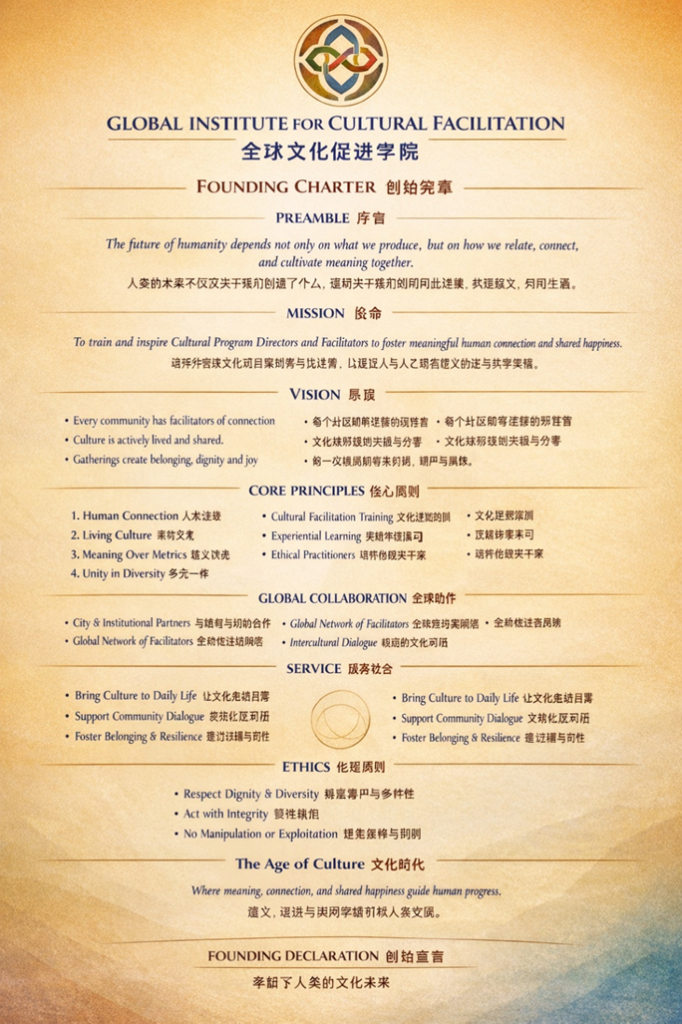
🌍GLOBAL INSTITUTE FOR CULTURAL FACILITATION    全球文化促进学

🌟 FOUNDING CHARTER 创始宪

PREAMBLE 序言

We live in a time of unprecedented connection, yet profound fragmentation.
Material progress has accelerated, yet meaning and belonging remain fragile.

我们生活在一个前所未有互联的时代,
却也面临深刻的分裂。
物质不断进步,但意义与归属感却日益脆弱。

The future of humanity depends not only on what we produce,
but on how we relate, connect, and cultivate meaning together.

人类的未来不仅取决于我们创造了什么,
更取决于我们如何彼此连接、共建意义、共同生活

🎯 MISSION 使命

To train and inspire Cultural Program Directors and Facilitators
to foster meaningful human connection and shared happiness.

培养并启发文化项目策划者与促进者,
以促进人与人之间有意义的连接与共享的幸福。

🌱 VISION 愿景

A world where:

  • Every community has facilitators of connection
  • Culture is actively lived and shared
  • Gatherings create belonging, dignity, and joy

一个世界,在那里:

  • 每个社区都有连接的促进者
  • 文化被积极地实践与分享
  • 每一次相聚都带来归属、尊严与喜悦

🧭 CORE PRINCIPLES 核心原

1. Human Connection 人本连接
Connection is the foundation of culture.
连接是文化的基础

2. Living Culture 活的文化
Culture is created through participation.
文化在参与中生成

3. Meaning Over Metrics 义优先
Value depth over mere numbers.
重视深度胜过数字

4. Unity in Diversity 多元一体
Differences enrich human experience.
差异丰富人类体验

5. Facilitation 导而非控制
True leadership creates space for others.
真正的领导是成就他人

6. Local & Global 本土与全球
Honor roots, embrace exchange.
尊重本土,促进交流

🎓 EDUCATION 教育使命

  • Establish training in Cultural Facilitation
  • Emphasize experiential learning
  • Cultivate ethical, capable practitioners
  • 建立文化促进专业培训体系
  • 强调实践与体验学习
  • 培养有能力、有责任感的实践者

🤝 GLOBAL COLLABORATION 全球

  • Partner with cities and institutions
  • Build a global network of facilitators
  • Promote intercultural dialogue
  • 与城市与机构合作
  • 建立全球促进者网络
  • 推动跨文化对话

🏙️ SERVICE 务社

  • Bring culture into daily life
  • Support community dialogue
  • Foster belonging and resilience
  • 让文化走进日常生活
  • 支持社区对话
  • 建立归属与韧性

⚖️ ETHICS 伦理原则

  • Respect dignity and diversity
  • Act with integrity
  • Avoid manipulation or exploitation
  • 尊重尊严与多样性
  • 坚持诚信
  • 避免操控与剥削

🌍 THE AGE OF CULTURE 文化

We affirm the emergence of an Age of Culture—
where meaning, connection, and shared happiness guide human progress.

我们共同确认一个“文化时代”的到来——
在这个时代,意义、连接与共同幸福将引领人类发展。

✍️ INVITATION

Let us build a world where:
No one is a stranger,
Every culture is a teacher,
Every gathering creates joy.

让我们共同建设一个世界:
没有陌生人,
每种文化都是老师,
每一次相聚都带来喜悦。

🌟 FOUNDING DECLARATION 创始宣

With hope and responsibility,
we dedicate this Institute to the cultural future of humanity.

怀着希望与责任,
我们将本学院奉献给人类的文化未来。
Identify various significant specific regional Cultures in History – Peace, War, Idealistic, Pragmatic, Agrarian, Hunting, Focusing on Happiness, etc. Which ones last or change why and how?- Billy – March 2026

ChatGPT:  This is a rich and important question—almost like mapping the “personality types” of civilizations across time. Let’s explore it in a way that’s both grounded and useful for your broader “Age of Culture” vision.


🌍 1. Major Cultural Types in History (with Examples)

🕊️ Peace-Oriented Cultures

  • Example: Bhutan (modern), ancient Buddhist kingdoms
  • Core values: harmony, balance, compassion
  • Measurement of success: well-being (e.g., “Gross National Happiness”)
  • Strength: social stability, mental well-being
  • Risk: vulnerability to aggressive neighbors

👉 These cultures often prioritize inner happiness over expansion.


⚔️ Warrior / Expansionist Cultures

  • Example: Sparta, Mongol Empire
  • Core values: strength, honor, discipline, conquest
  • Strength: rapid expansion, strong unity under threat
  • Risk: burnout, collapse after over-expansion

👉 These cultures often don’t last long in their original form—they either:

  • transform into administrative states, or
  • fragment after peak expansion

🌱 Agrarian Civilizations

  • Example: Ancient Egypt, Imperial China
  • Core values: stability, continuity, land stewardship
  • Strength: long-term endurance (centuries to millennia)
  • Risk: resistance to change, vulnerability to disruption

👉 These are among the longest-lasting cultural systems in history.


🦌 Hunting / Nomadic Cultures

  • Example: Indigenous peoples of the Great Plains, Central Asian nomads
  • Core values: adaptability, survival, relationship with nature
  • Strength: resilience, mobility
  • Risk: displacement by settled civilizations

👉 These cultures endure as identities, even when political power is lost.


🧠 Idealistic / Philosophical Cultures

  • Example: Athens, Axial Age
  • Core values: truth, beauty, ethics, knowledge
  • Strength: long-lasting intellectual influence
  • Risk: political weakness or internal division

👉 Their ideas often outlive their political structures by thousands of years.


⚙️ Pragmatic / Administrative Cultures

  • Example: Roman Empire, modern technocratic states
  • Core values: law, order, infrastructure, efficiency
  • Strength: scalability, governance, systems
  • Risk: loss of meaning, over-bureaucratization

👉 These cultures often evolve rather than collapse outright.


😊 Happiness / Well-being Focused Cultures

  • Example: Bali (community ritual life), Bhutan again
  • Core values: joy, ritual, togetherness, spirituality
  • Strength: strong social bonds, life satisfaction
  • Risk: economic or military vulnerability

👉 These cultures are often quietly resilient, though less dominant globally.


🔄 2. Why Some Cultures Last (and Others Don’t)

A. Longevity Factors (Why Cultures Endure)

1. Balance Between Stability and Adaptation

  • Imperial China lasted ~2,000 years because it:
    • preserved core values (Confucianism)
    • adapted institutions over time

👉 Lesson: Too rigid = break. Too flexible = lose identity.


2. Strong Cultural Narratives

  • Shared stories, rituals, and meanings
  • Example: Hinduism has endured for millennia

👉 Culture lasts when people feel it, not just follow it.


3. Social Cohesion (Trust + Belonging)

  • Communities that eat together, celebrate together, mourn together
  • These outlast purely economic systems

👉 This aligns strongly with your interest in togetherness and gratitude.


4. Ability to Absorb Others

  • Roman Empire integrated diverse peoples
  • Ottoman Empire allowed cultural pluralism

👉 Cultures that include rather than exclude tend to survive longer.


B. Causes of Cultural Decline or Transformation

1. Overemphasis on One Value

  • Sparta → too militaristic
  • Late Rome → too materialistic

👉 Imbalance leads to fragility.


2. Loss of Meaning

  • When people stop believing in shared values
  • Cynicism replaces purpose

👉 This is one of the biggest modern risks.


3. External Pressure

  • Invasions, colonization, economic domination
  • Hunting cultures especially affected

4. Success Leading to Complacency

  • Prosperity reduces discipline and unity
  • Internal decay replaces external threat

🌱 3. A Deeper Pattern (Across All Cultures)

Almost every long-lived civilization cycles through:

  1. Formation (Idealism)
  2. Expansion (Energy, sometimes war)
  3. Stability (Agrarian/pragmatic balance)
  4. Comfort (Wealth, refinement)
  5. Drift (Loss of meaning)
  6. Transformation or Collapse

👉 This pattern echoes thinkers like Arnold Toynbee and Will Durant.


🌼 4. What This Means for “The Age of Culture”

If you’re thinking about building a future-oriented cultural movement, history suggests:

The most sustainable culture combines:

  • 🧠 Idealism (meaning)
  • ⚙️ Pragmatism (function)
  • 🌱 Stability (tradition)
  • 😊 Joy (human connection)

👉 Not one type—but a harmonized culture.


A Simple Insight to Carry Forward

Cultures don’t last because they are strong.
They last because they remain meaningful to the people living inside them.

Holistic Thinking vs Rushed Economic Pursuits. Five different situations describing the pros and cons for promoting The Age of Culture over The Age of Economics.- Billy – March 2026

ChatGPT:   That’s a rich and important contrast. Think of it this way: Holistic thinking asks “What kind of life are we building?” while rushed economic pursuit asks “How fast can we produce and profit?”.

Both have value—but they lead societies in different directions. Below are five everyday situations where the Age of Culture and the Age of Economics reveal their strengths and weaknesses.


Holistic Thinking vs. Rushed Economic Pursuits

Five Situations Comparing the Age of Culture and the Age of Economics

SituationAge of Economics (Rushed Pursuit)ProsConsAge of Culture (Holistic Thinking)ProsCons
1. Urban DevelopmentBuild quickly for profit (luxury housing, malls)Fast growth, jobs, tax revenueLoss of heritage, displacement, anonymous citiesDesign cities with parks, arts spaces, cultural identityStrong community life, civic pride, healthier livingSlower approval, sometimes higher cost
2. Education SystemsFocus on job training, STEM, market competitivenessEfficient workforce preparationNeglect of arts, ethics, and citizenshipBalanced learning: arts, humanities, sciencesMore creative, thoughtful citizensHarder to measure economic return
3. Work and LifestyleLong work hours, productivity metricsHigher income potentialBurnout, loneliness, stressTime for family, music, festivals, reflectionHigher life satisfaction and meaningSlower economic output
4. Technology DevelopmentRelease products rapidly to capture marketsInnovation speed, economic growthEthical risks, addiction, social fragmentationDevelop technology with ethical and cultural considerationsHealthier digital cultureSlower commercialization
5. Community LifeIndividual success and competitionPersonal ambition encouragedSocial isolation, declining trustShared rituals, arts gatherings, public conversationsStrong friendship networks, resilienceRequires effort and civic participation

The Age of Economics asks:

  • How much?
  • How fast?
  • How profitable?

The Age of Culture asks:

  • Why?
  • For whom?
  • What kind of civilization does this create?

One emphasizes quantity, the other quality of life.


A Balanced Insight

The goal is not eliminating economics.
Economics is a tool. But culture is the compass.

_____________________________________________________________________________

A Simple Guiding Sentence for the Age of Culture

English
“Let economics serve life, and let culture guide civilization.”

Chinese
让经济服务生活,让文化引领文明。

Creating and Initiating Conversations on Age of Culture Globally. – Starting a Global Network In Informing, Sharing, and Promoting – Billy -March 2026

ChatGPT:  Here is a small, practical “mini example” of how someone could start a conversation about the “Age of Culture” anywhere in the world—in a café, a conference, a university, or an online gathering. Think of it like lighting a small candle rather than a bonfire. 🕯️

__________________________________________________

 Mini Example: Starting a Conversation on the Age of Culture

Setting: A small international gathering—maybe 5–8 people from different countries.

Step 1 — Begin with a Simple Observation

Instead of arguing against economics, begin with curiosity.

You might say:

“For the last 200 years the world has focused heavily on economic growth.
But I wonder if the next era might be something different —Perhaps an Age of Culture, where meaning, creativity, and human connection become the main drivers of progress.”

This invites reflection rather than debate.

Step 2 — Ask One Universal Question

A good global question works across cultures.      Examples:

• “What cultural experience has given you the deepest happiness?”
• “When did art, music, food, or tradition bring people together in your life?”
• “If culture shaped the future more than money, what might the world look like?”

People immediately have stories.

Step 3 — Let Stories Lead

Participants might share things like:

  • a grandmother’s cooking tradition
  • music festivals
  • indigenous ceremonies
  • neighborhood gatherings
  • art or poetry movements

At this moment the idea of culture becomes personal rather than theoretical.

Step 4 — Introduce the Age of Culture Concept

After listening, gently frame the idea:

“What we are describing might be the beginning of an Age of Culture —
where societies measure success not only by GDP, but by shared meaning, creativity, and       belonging.”

These echoes ideas promoted by cultural thinkers like D. Paul Schafer , who has argued that culture should guide the future of civilization.

Step 5 — End With One Forward Question

Instead of concluding- (closing), let the door open to welcome more energy.

• “What small cultural activity could we start together?”
• “What tradition from your culture should the world experience?”
• “How can friendship spread culture faster than institutions?”

This turns the conversation into forthcoming Possibilities.

___________________________________________________

A Three-Minute Talk Promoting: The Age of Culture

Good evening friends,

For most of the last two hundred years, the world has been guided by one powerful idea: economic growth. Nations measure success by productivity, markets, and GDP. These things have helped improve material life for many people, and we should appreciate that.

But something important has also become clear.

Even in wealthy societies, many people feel lonely, divided, or searching for meaning. Economic progress alone has not answered the deeper human questions:
What gives life meaning? What brings us together? What makes us truly happy?

This is where a new idea begins to emerge.

Some thinkers, including cultural scholar D. Paul Schafer, suggest that humanity may be entering a new era — the Age of Culture.

In the Age of Culture, culture is not just entertainment or decoration.
Culture becomes the guiding force of society.

Culture means the music we share.
The stories we tell.
The food we cook together.
The traditions that connect generations.
The arts that express who we are.
And the friendships that make life meaningful.

When culture flourishes, something beautiful happens.

People begin to feel belonging instead of isolation.
Communities celebrate diversity instead of fearing it.
Creativity grows.
Understanding deepens.

In fact, culture may be one of the most powerful ways to bring peace in a world often divided by politics and economics.

Think about it for a moment.

When people sing together, they are not enemies.
When they share food, they become friends.
When they listen to each other’s stories, they discover their common humanity.

Culture quietly builds bridges where arguments cannot.

So perhaps the question for our time is this:

What if we measured progress not only by economic wealth, but also by cultural richness?

What if success meant:

More music in our communities,
More art in our cities,
More traditions shared across cultures,
More friendships across differences.

In such a world, prosperity would not disappear.
But it would serve a larger purpose — human flourishing.

The Age of Culture is not something governments alone can create.

It begins with people.

It begins when we gather.
When we share music, meals, and ideas.
When we celebrate the beauty of different cultures.
When we create spaces of conversation and friendship.

Each small gathering becomes a seed.

And perhaps, slowly, those seeds will grow into a world where culture helps guide humanity toward greater happiness, understanding, and peace.

Thank you.

____________________________________________________

Creating Settings for “Age of Culture” Conversations

1. Physical Places that Invite and Induce Conversations

Friendship Benches

Cities could install “Friendship Benches” in parks or cultural districts.

Inscription example: “Sit here to share a story from your culture.”

These could be Sister City gifts, linking communities internationally through networks like Sister Cities International.

Each bench could include a QR code connecting to a global cultural conversation network.

Cultural Conversation Tables

In senior centers, cafés, and libraries.

Instead of table numbers, give tables names like:

• Story Table
• Wisdom Table
• Memory Table
• Music Table
• Poetry Table

A small card could ask:

“What tradition from your childhood should the world not forget?”

Cultural Lantern Evenings

Once a month in parks or community halls.   Participants bring:

• a song
• a story
• a recipe
• an object from their culture

The Listening Circle

A simple format used in many indigenous cultures.   Rules:

  1. One person speaks
  2. Others listen
  3. No interruption
  4. Story before opinion

This fosters respectful cultural dialogue.

2. Roles That Stimulate Conversation

Community Storytellers

Communities could introduce visiting storytellers.

Examples:

• musicians
• elders
• poets
• travelers
• immigrants with life stories

The model resembles cultural storytelling performances by artists like Hershey Felder, who combine narrative and music.

Cultural Hosts

Every gathering benefits from someone who gently asks questions.

Example prompts:

• “What music shaped your childhood?”
• “What festival means the most in your culture?”
• “What dish reminds you of home?”

Friendship Ambassadors

People who simply introduce strangers to each other.

You once mentioned how important introductions are in building friendships — this is exactly where that idea becomes powerful.

3. Conversation Prompts in Public Spaces

Short prompts can be placed on:

• café napkins
• library bookmarks
• festival posters
• transit screens

Examples:

“What tradition brings your family together?”

“What music makes you feel alive?”

“What story from your culture should the world hear?”

These small prompts create unexpected meaningful conversations.

4. Cultural Salons

Inspired by historical salons in cities like Paris and Vienna.

Small gatherings in homes or community spaces.

Typical structure:

  1. Welcome and introductions
  2. One cultural performance (music, poetry, storytelling)
  3. Conversation
  4. Shared food

This format creates intellectual friendship networks.

5. A Network of “Age of Culture” Publications

Cultural Letters Newsletter

Small local publications.

Each issue could include:

• one cultural story
• one artist
• one cultural tradition
• one friendship story
• one question for readers

These could form a global network of cultural newsletters.

Example Titles

• The Cultural Exchange
• The Friendship Chronicle
• Culture & Community
• The Age of Culture Letter
• The Global Story Journal

These newsletters could feature ideas from cultural thinkers like D. Paul Schafer who advocate a stronger role for culture in shaping society.

6. Cultural Rituals for Everyday Life

Small rituals help conversations start naturally.      Examples:

Story of the Week

In cafés or schools:

“Tell us a story from your culture.”

Music Exchange Nights

Each person introduces one song from their culture.

Recipe Conversations

People bring dishes and explain:

• history
• family story
• meaning

7. Global Digital Layer

A simple online platform.   Features:

• map of cultural salons
• story submissions
• local cultural events
• cultural conversation guides

Think of it as a worldwide cultural conversation map.

8. Cultural Symbols That Invite Curiosity

Objects that spark dialogue:

• cultural flags
• musical instruments
• historical photographs
• traditional clothing displays

People naturally ask questions.

9. Cultural Friendship Festivals

Small festivals focused on:

• sharing traditions
• storytelling
• food
• music
• conversation circles

The emphasis is participation, not just spectatorship.

The Secret Ingredient

The real driver of the Age of Culture is friendship.

Friendship is the fastest path to cultural understanding.

When people become friends, cultures stop being “foreign.”

They become shared experiences.

You don’t need a large institution to start the Age of Culture.

One table
One bench
One storyteller
One friendship

And suddenly culture begins to breathe again in a community.

_____________________________________________________

The Age of Culture Starter Kit

1.One-Page Vision Poster For Cities and Communities   explaining:  “The Age of Culture”

Key message:

  • Economic progress improves living standards
  • Culture improves quality of life

           “A great city is not only prosperous — it is culturally alive.”

Place the poster in:

  • libraries
  • schools
  • cafés
  • community centers
  • city halls

2. Cultural Conversation Cards

Small cards used in gatherings.    Example prompts:

• “What music shaped your childhood?”
• “What tradition from your culture should never disappear?”
• “What meal brings your family together?”
• “What story from your grandparents should the world hear?”

3. Friendship Benches

Install “Friendship Benches” in parks.

Inscription example:  “Sit here to share a story.”

Cities could exchange these through partnerships like
Sister Cities International.

Each bench becomes a place where strangers become friends.

4. Cultural Salons Monthly gatherings in homes, libraries, or cafés.

Format:

  1. Welcome
  2. One music or poetry piece
  3. One personal story
  4. Open conversation
  5. Shared food

These salons recreate the great conversation cultures of history.

5. Community Storyteller Program

Invite storytellers to visit neighborhoods Examples:

  • musicians
  • poets
  • immigrants with life stories
  • elders with historical memories

Artists such as Hershey Felder show how storytelling can turn culture into a vivid shared experience.

6. Cultural Tables At senior centers, libraries, or cafés.

Instead of table numbers:

  • The Story Table
  • The Wisdom Table
  • The Music Table
  • The Poetry Table

Each table includes a conversation prompt card.

7. Cultural Festivals of Gratitude Annual or seasonal gatherings celebrating:

  • music
  • art
  • food
  • storytelling
  • traditions

Focus on participation rather than spectatorship.

Everyone brings something from their culture.

8. Cultural Happiness Check

Communities periodically ask:

“How culturally alive is our community?”

Indicators:

  • music events
  • art participation
  • storytelling gatherings
  • cultural diversity exchange
  • friendships across cultures

This becomes a Cultural Value Index.

9. Cultural Letter Newsletter

A small community publication. Each issue includes:

  • a cultural story
  • a local artist
  • a tradition
  • a friendship story
  • a cultural event calendar

Over time, these newsletters could become a global cultural network.

10. Cultural Host Training

Train volunteers to facilitate cultural conversations. (Truly Important as Teachers in Schools.)

Skills include:

  • asking good questions
  • introducing strangers
  • encouraging storytelling
  • moderating respectfully

These hosts are ambassadors of cultural connection.

11. Intergenerational Culture Circles Bring together:

  • elders
  • students
  • immigrants
  • artists

Topics include:

  • childhood traditions
  • historical experiences
  • music and memory
  • food heritage

This preserves cultural memory while strengthening community bonds.

12. The Global Cultural Map

Cities join an international map showing:

  • cultural salons
  • storytelling gatherings
  • cultural festivals
  • friendship bench locations

People traveling anywhere can join local cultural conversation.

______________________________________________________

The Spirit Behind the Starter Kit

The Age of Culture does not reject economics.

Instead, it says:

Economics should support life — but culture gives life meaning.

Culture helps people experience:

  • belonging
  • creativity
  • identity
  • friendship
  • shared joy

Charter Commitments

Cities and Communities: adopting this Charter affirm the following principles.

1. Culture as a Guiding Force

We recognize culture as a fundamental pillar of civic life, alongside economic vitality and social well-being.

2. Cultural Participation for All

Every resident should have opportunities to participate in cultural life—through music, art, storytelling, traditions, and community celebrations.

3. Spaces for Cultural Gathering

We will encourage the creation of public spaces that invite conversation, creativity, and cultural exchange.

Examples include:

  • cultural salons
  • storytelling gatherings
  • friendship benches
  • community festivals

4. Celebration of Cultural Diversity

Our cities are strengthened by the diversity of cultures within them. We celebrate and support the sharing of traditions, languages, and heritage.

5. Intergenerational Cultural Memory

We honor the wisdom of elders and the creativity of youth by encouraging the sharing of stories, traditions, and cultural experiences across generations.

6. Culture as a Bridge Between Peoples

Cultural exchange helps build friendship across communities and nations.

Cities will strengthen cultural diplomacy through partnerships such as
Sister Cities International and other global cultural collaborations.

7. Culture and Well-Being

We recognize that cultural participation contributes to:

  • happiness
  • belonging
  • creativity
  • mental and emotional health

A culturally vibrant city is a healthier city.

8. Support for Artists and Cultural Storytellers

Artists, musicians, writers, and storytellers enrich the life of cities. We encourage communities to support those who help express and share our collective cultural experience.

9. Cultural Conversations

We encourage gatherings that foster meaningful conversations about culture, identity, and shared human experiences.

10. Global Cultural Friendship

Cities adopting this Charter commit to sharing cultural knowledge and experiences with other communities around the world.

Organizations such as UNESCO have long recognized culture as a foundation for peace and understanding.

____________________________________________________________________________________

Our Common Vision

We envision cities where:

  • music fills public spaces
  • stories are shared across cultures
  • art inspires imagination
  • traditions are celebrated
  • strangers become friends

In such cities, prosperity and culture grow together.

Economic success provides resources.

Culture provides meaning and belonging.

Friendship Cultural Salons – Small cultural gatherings often produce unusually Deep Happiness and Community Bonds. Not grand spectacles—but Intimate Human Exchanges. ChatGPT – March 2026

1. Human-Scale Connection

Large events often create spectators.
Small gatherings create participants.

Large Events    Small Cultural Gatherings
anonymous crowds    personal presence
passive watching    shared participation
short interactions    deeper conversations

When 6–20 people gather for:

  • music
  • storytelling
  • poetry
  • thoughtful conversation
  • shared meals

Everyone can see and hear one another. The brain reads faces, tone, and emotion more clearly. This activates our natural social bonding system.

2. Shared Emotional Experience

When people listen to music or a story together in a small space, something subtle happens.

Their emotions begin to synchronize.

Psychologists call this emotional entrainment.

For example:

  • a quiet piece of music slows breathing
  • a humorous story creates shared laughter
  • a touching memory creates shared silence

These synchronized moments build deep social cohesion.

“We experienced something meaningful together.”

3. Safe Space for Authentic Conversation

Small gatherings reduce the pressure of public performance.

People feel safer to express:

  • ideas
  • doubts
  • personal stories
  • reflections

Authenticity is one of the strongest drivers of friendship.

Large social environments often reward status and image.
Small circles reward presence and sincerity.

4. Cultural Enrichment Without Competition

In intimate gatherings, culture becomes shared nourishment, not competition.

Atmosphere becomes: “Let’s experience something meaningful together.”

Music, poetry, or ideas become gifts exchanged among friends.

5. Slower Time

Modern life moves quickly.  Small gatherings slow things down.

A typical evening might include:

  • a shared meal
  • someone playing music
  • a poem or story
  • relaxed conversation

Slower rhythms allow the mind to settle and appreciate.

Many people report leaving such gatherings feeling:

  • calmer
  • connected
  • inspired

6. Historical Examples

Many vibrant cultural periods were fueled by small circles rather than large institutions

  • European salons where writers and philosophers exchanged ideas
  • Chinese literati gatherings combining poetry, calligraphy, and tea
  • Middle Eastern majlis gatherings of conversation and music
  • early American parlor music evenings

These circles often produced new ideas, art, and lifelong friendships ( some after heated debates )

7. Friendship as Cultural Soil

Culture flourishes best where friendship exists.   Friendship creates:

  • trust
  • patience
  • generosity
  • curiosity

When these qualities exist, culture becomes alive, not just performance.

Instead of consuming culture, people create culture together.

Friendship Cultural Salon Manifesto: 

English中文
We gather as friends. Not to impress one another, but  to know one another.们以朋友相聚。 不是为了彼此炫耀,而是为了彼此了解。
We share culture. Music, stories, art, and ideas remind us of the beauty of being human.们分享文化。 音乐、故事、艺术与思想提醒我们做人之美。
We listen with respect. Every voice carries experience, memory, and wisdom.们以尊重倾听。 每一种声音都承载着经验、记忆与智慧。
We speak with sincerity. Honest words create trust and friendship.们以真诚发言。 真诚的话语建立信任与友谊。
We welcome differences. Diversity of thought enriches understanding.们欢迎差异。 不同的思想使理解更加丰富。
We seek meaning. Beyond noise and haste, we look for what gives life depth.们追寻意义。 在喧嚣与匆忙之外,我们寻找生命的深度。
We nourish friendship. Conversation, shared meals, and shared beauty strengthen our bonds.们滋养友谊。 交谈、共餐与共享美好,使情谊更加深厚。
We leave inspired. Carrying kindness, insight, and gratitude into the wider world.们带着启发离开。 将善意、洞见与感恩带回更广阔的世界。

___________________________________________________________________________________

友文会心“    Friends Meet Through Culture.”

Pinyin: Yǒu Wén Huì Xīn

Meaning:
Friends gather through culture, hearts meet in understanding.

  • — friendship
  • — culture, arts, refinement
  • — gathering / meeting
  • — heart / inner understanding

__________________________________________________________________________________

Historically, many influential ideas in Art, Music, and Philosophy were not born in universities or concert halls — but in living rooms. Three fascinating examples.

1. Paris Literary Salons (17th–19th Century) famous intellectual gatherings in history.

Guests included philosophers, writers, artists, diplomats, and scientists such as Voltaire and Denis Diderot.

Typical activities:

  • reading essays
  • debating philosophy
  • discussing politics
  • sharing literature
  • forming intellectual friendships

Small gatherings can change the intellectual climate of a society.


2. Vienna Musical Salons (18th–19th Century)

Vienna had a rich culture of music salons held in aristocratic homes.

One famous tradition was the Schubertiade, informal evenings where Schubert and friends performed songs and chamber music.

Audience members were often friends and patrons, not anonymous ticket buyers.

Many masterpieces were first heard in intimate rooms, not large concert halls.

Art becomes more human and meaningful when shared in small communities.


3. Shanghai Cultural Salons (Early 20th Century)

During the early 20th century, Shanghai became a hub of modern Chinese culture.

Writers, artists, and intellectuals gathered in homes, cafés, and studios.

Figures such as Lu Xun influenced discussions about literature, society, and modernization.

These gatherings blended:

  • Chinese classical traditions
  • Western ideas
  • modern art and literature

Shanghai salons were bridges between civilizations.

helped shape modern Chinese cultural identity.

______________________________________________

A Beautiful Thought :

The historian Hannah Arendt once suggested that civilization survives through spaces where people meet as equals to share ideas and beauty.

________________________________________________