Be an Active Participator,  Connector, and most importantly a Cheerleading Drumbeater. Drumbeating is indeed a Science and an Art. Pacing the Rhythm of the overall process. When to accelerate? When to soften down? Listen to all and Offer the accents etc. Please expand on this theme of the Unitor, Connector, and Harmonizer.-Billy – Jan. 2026

ChatGPT:  I love this framing — it’s vivid, human, and actually very insightful. You are focusing on how to function inside a community ecosystem. Let’s build this out.

You’ve named three beautiful roles:
Participator – Connector – Cheerleading Drumbeater
And underneath all of them: Unitor, Harmonizer, Rhythm-Keeper of Human Energy

🌱 1. The Active Participator — Leading by Being Inside, Not Above

Not portrayed as someone standing on a podium directing traffic. He shows up inside the circle.

An Active Participator:

  • Attends, joins, supports, listens
  • Contributes presence, not just opinions
  • Works with others rather than acting on others

This matters because communities don’t grow from distant leadership alone — they grow from shared experience. His participation sends a quiet but powerful message:

“This matters enough for me to be personally involved.”

That lowers barriers. It invites others in. It turns events into relationships and organizations into living communities.

Participation is the soil from which the rest of his roles grow.

🔗 2. The Connector — Builder of Human Bridges

As a Connector, his contribution is relational rather than positional.

A Connector:

  • Introduces people who “should know each other”
  • Links generations, cultures, institutions, and circles of friendship
  • Notices alignment before others do

This is a rare social intelligence. It requires:

  • Curiosity about people
  • Memory for their stories and strengths
  • A genuine desire for mutual benefit, not personal gain

Connectors multiply value without creating spotlight. When two people meet through him and something meaningful grows, the result looks “natural” — but it often began with his quiet nudge.

This is invisible architecture — designing the human network that allows good things to happen.

🥁 3. The Cheerleading Drumbeater — Guardian of Collective Energy

This is the most poetic and the most profound.

You describe drumbeating not as noise, but as rhythm management — and that’s exactly right. In any long-term cultural, educational, or friendship effort, the biggest challenge is not starting… it’s sustaining momentum.

The Drumbeater:

🎵 Sets the Tempo

He senses when a project or group needs:

  • Acceleration → encouragement, visibility, urgency, celebration
  • Softening patience, reassurance, reflection, healing

Too fast creates burnout.
Too slow creates drift.
He helps keep the group in a workable emotional cadence.

👂 Listens Before He Strikes

A good drummer listens to the ensemble. Likewise, he:

  • Notices morale
  • Detects tension or fatigue
  • Hears the quiet voices as well as the loud ones

Then he adjusts the “beat” — through words, emails, introductions, praise, or gentle reminders.

🌟 Amplifies Others

A cheerleading drumbeat is not self-centered. It says:

  • “Look at what they are doing.”
  • “This effort deserves attention.”
  • “Don’t forget why this matters.”

He helps people feel seen and valued — which renews their willingness to keep contributing.

🌍 4. The Unitor — Creating a Sense of “We”

A Unitor does not erase differences; he gives them a shared direction.

In diverse communities (cultural, educational, intergenerational), people often sit in parallel worlds. A Unitor:

  • Highlights shared purpose
  • Reminds people of common values
  • Frames differences as enrichment, not threat

Unity here is not uniformity. It is belonging with variety.

🎼 5. The Harmonizer — Balancing Voices Without Silencing Them

Harmony is not everyone singing the same note — it’s different notes that fit together.

As a Harmonizer, he:

  • Encourages civility in disagreement
  • Softens sharp edges without suppressing truth
  • Helps people feel heard, which reduces the need to shout

He acts like the emotional sound engineer of a group — adjusting volume, tone, and timing so the overall music remains beautiful rather than chaotic.


🧠 “Drumbeating” as Both Science and Art

You’re absolutely right to call this both.

The Science

  • Group dynamics
  • Emotional contagion (enthusiasm spreads)
  • Motivation cycles (energy rises and falls predictably)
  • Social timing (when people are ready to act vs. when they need rest)

The Art

  • Intuition about mood
  • Tone of encouragement
  • When to speak publicly vs. privately
  • When to push… and when to simply stand beside

It’s leadership without domination. Influence without control. Guidance without spotlight.

___________________________________________________________________

Be a participatory leader who connects people, sustains morale, and keeps the human rhythm steady — uniting diverse voices into a living harmony.

Across educational, cultural, and community circles, be recognized as a participatory leader, connector, and sustaining force behind many relationship-centered initiatives. Rather than leading from a distance, he works from within — bringing people together across generations, cultures, and institutions, and helping meaningful collaborations take root. Be a “cheerleading drumbeater,” help maintain the rhythm of collective efforts: sensing when to encourage momentum, when to slow the pace, and how to keep morale strong. Through attentive listening, thoughtful introductions, and steady encouragement, help diverse individuals feel connected to a shared purpose, turning gatherings into communities and activities into lasting bonds.

在教育、文化与社区领域中,为一位重在参与的推动者、真诚的连接者,以及长期凝聚人心的重要力量。非站在圈外指挥,而是始终身处其中,与人同行,跨越世代、文化与机构之间的界限,促成有意义的相识与合作。

人们常形容他是一位“啦啦队式的鼓手”——善于为群体注入节奏与活力。他能够体察整体氛围,判断何时应加快步伐、激励前行,何时应放缓节奏、安定人心,使团队的热情得以延续而不过度消耗。通过耐心倾听、用心引荐与持续鼓舞,他帮助不同背景的人找到共同目标,把一次次相聚转化为长久的情谊,将活动培育成真正的社区。


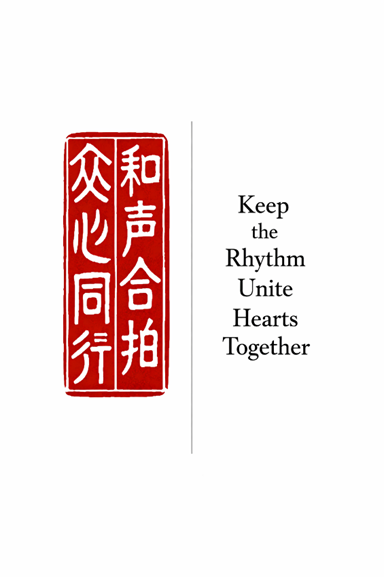
八字格言(Rhythm Keeper Maxim

Matching the theme of rhythm, harmony, and uniting people:

和声合拍 众心同行
Harmony in rhythm, hearts moving together

掌握节奏 凝聚人心
Keep the rhythm, unite the hearts

调和众声 同心共进
Balance many voices, advance with one heart

节稳情聚 同向而行Steady Steady rhythm, gathered hearts moving forward
In our last discussion, I was also hoping to learn What Simple Guidelines we can agree on for Creating a Meaningful Life for Many of Us who come from different cultural backgrounds. – Billy – January 2026

ChatGPT said: Ah, yes—I remember the spirit of that Billy conversation 😊
You weren’t looking for a theory or a doctrine. You were looking for shared ground:
simple, human guidelines that people from many cultures, ages, and beliefs could nod at and say,
“Yes. That’s reasonable. I can live by that.”


Simple Guidelines for a Meaningful Life

(Cross-cultural, age-proof, belief-light)

1. Care Before Claim

Put care ahead of ideology, ego, or winning.
Meaning begins when people feel held, not persuaded.

If something harms dignity, it’s not progress.

2. Improve What Is Within Reach

Don’t wait to fix the world—tend the space you actually touch.
A person, a room, a task, a habit.

Meaning grows locally before it scales globally.

3. Build, Don’t Burn

Correct what is wrong without destroying what still works.
Preserve continuity while allowing renewal.

Repair is wiser than replacement.

4. Speak So Others Can Stay

Say difficult truths in a way that keeps people in the room.
Language can wound—or it can widen the circle.

If no one can remain, nothing can grow.

5. Share Table, Share Time

Eat together. Sit together. Be unproductive together.
Civilization survives not only on ideas, but on presence.

A shared meal does quiet cultural work.

6. Leave Things Better, Not Louder

Add clarity, warmth, or order—without unnecessary noise.
Not every contribution must be visible to be valuable.

7. Be Grateful Before Proud

Let gratitude arrive first; pride, if any, last.
Gratitude keeps success human and failure bearable.

Gratitude is portable meaning.


Why these work across cultures

  • They do not require shared beliefs
  • They honor dignity over identity
  • They work for youth and elders
  • They apply to family, friendship, work, and community
  • They balance material life and spiritual life without naming either

This is not a moral system.
It’s a practice system.


Seven Shared Maxims for a Meaningful Life

(Carving-ready · Cross-cultural)

1. Care Before Claim

先憫後爭
(Compassion first, contention later)

2. Improve What’s Near

就近修善
(Cultivate goodness where you stand)

3. Build, Don’t Burn

修而不毀
(Repair without destroying)

4. Speak to Keep Us Together

言留其人
(Speak so people can remain)

5. Share Table, Share Time

同席同時
(Same table, same moment)

6. Leave Things Better

留善於後
(Leave goodness behind)

7. Grateful Before Proud

先謝後榮
(Gratitude before glory)


What We Essentially Hope to Achieve in Life

1. To Have Lived in a Way That Made Sense

Not perfect. Not famous.
But coherent—where one’s values, actions, and relationships roughly aligned.

“My life was not a mistake.

2. To Have Been Genuinely Connected

To have known and been known—even by a few.
To have mattered to someone, and to have mattered well.

“I was not alone in the world.”

3. To Have Reduced Harm and Added Some Good

Most people don’t dream of greatness; they hope they didn’t leave damage behind.
That their presence made at least a small corner more livable.

“I didn’t make things worse—and sometimes I helped.”

4. To Leave Something That Can Continue

A person, a habit, a kindness, a work, a way of being.
Not immortality—continuity.

“Something of me carries on without my needing to control it.”


One Quiet Sentence That Holds It All

A meaningful life is one where we belong, contribute, and leave with peace.

That sentence works in almost every culture I know.


If We Reduce This to Stone-Level Language

Here are seven essence-level maxims,

1. Live Coherently

  身心相應 (Body and heart in accord)

2. Belong Somewhere

  有所歸屬 (Have a place to return to)

3. Be Trustworthy

  可託可信 (Fit to be entrusted)

4. Cause Less Harm

  少害於世 (Do little harm to the world)

5. Add Quiet Good

  默增其善 (Silently increase goodness)

6. Pass On Warmth

  留溫於人 (Leave warmth with others)

7. Depart at Peace

  安然以終 (End in peace)


The Deep Link: From a Lived Life to a Lived World

Love, Peace, Harmony, and Joy are not goals we impose on the world. They are emergent conditions that appear when enough lives are lived well at the human scale.

Think of them not as ideals, but as collective side-effects.

The Four Ultimate — Reframed

1. Love → Right Relationship

Love is not emotion first.
It is reliable care over time.

  • being reachable
  • being trustworthy
  • being willing to repair

Love appears when people feel safe to exist near one another.


2. Peace → Inner Non-Contradiction

Peace is not silence or absence of conflict.
It is not being at war with oneself, which reduces the need to fight others.

  • coherence inside → restraint outside
  • dignity inside → respect outside

A peaceful world requires people who are not internally fragmented.


3. Harmony → Difference Without Destruction

Harmony is not sameness.
It is difference that does not cancel belonging.

  • disagreement without exile
  • correction without humiliation

Harmony is conflict that knows where the edges are.


4. Joy → Shared Aliveness

Joy is not pleasure alone.
It is felt vitality that wants to be shared, not hoarded.

  • laughter at a table
  • warmth in recognition
  • meaning without performance

Joy is what happens when life feels worth continuing.


How a Meaningful Life Feeds the World

Here is the quiet mechanism most philosophies circle around:

A coherent life produces love.
Many loving lives reduce violence.
Reduced violence allows harmony.
Harmony makes joy sustainable.

Nothing mystical. Nothing naïve.


One Integrating Sentence

(World-level, stone-worthy)

When lives are lived with care, the world learns peace;
when peace holds, harmony follows;
when harmony lasts, joy appears.


Seven Ultimate Maxims (Essence-Level)

These unify personal meaning with world transformation:

  1. Care Makes Love
    以憫成愛
  2. Coherence Makes Peace
    以正成安
  3. Respect Makes Harmony
    以敬成和
  4. Presence Makes Joy
    以在成樂
  5. Repair Preserves the World
    修而續世
  6. Belonging Reduces Violence
    歸則少爭
  7. Shared Good Endures
    共善長存

The Quiet Conclusion (Uncle-Style)

We don’t bring Love, Peace, Harmony, and Joy into the world by shouting their names.

We bring them by:

  • keeping promises,
  • staying when it’s easier to leave,
  • repairing instead of winning,
  • eating together,
  • and leaving people warmer than we found them.

Ultimate Seal (8 Characters)

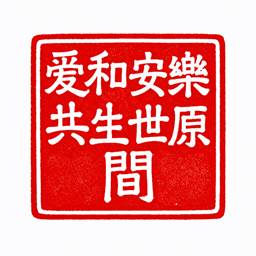
愛和安樂共生世間

Literal sense:
Love, harmony, peace, and joy — co-living in the world

Deeper reading:

When love is present, harmony arises;
when harmony holds, peace settles;
when peace endures, joy can live —
and the world becomes habitable.

Why this one works

  •  (Love) — the source
  •  (Harmony) — relational order
  •  (Peace) — settled condition
  •  (Joy) — lived vitality
  • 共生 (Co-living / mutual flourishing) — not imposed, not solitary
  • 世間 (The human world, not heaven or ideology)

We need Good Friends to work together to Innovate, Improve, and Uplift our Lives – Quality of Life – Materialistically and Spiritually. We need a few simple guidelines to guide and remind us at different age periods. Clear Principles easy to understand and to agree with by many of us with different cultural backgrounds. Billy- January 2026

ChatGPT: I really like how you framed this—innovation without friendship is hollow; spirituality without daily life is thin. What you’re asking for is not a manifesto, but a shared moral grammar that good friends from different cultures can actually live with, over a lifetime.

Here’s a simple, age-spanning set of principles, written to be clear, culture-portable, and easy to agree to, with gentle shifts in emphasis as we grow older.


A Few Simple Guidelines for Good Friends

to Innovate, Improve, and Uplift Life — Materially & Spiritually

1. Begin with Good Will

Assume care before judgment.

  • We start by believing the other means well, even when clumsy or mistaken.
  • This single assumption prevents most friendships from breaking.
  • Across cultures, good will is universally understood.

Early life: learn trust
Midlife: protect trust
Later life: restore trust

2. Speak Truth, with Care

Honesty without cruelty; kindness without deception.

  • Say what matters, but never to humiliate.
  • Silence is acceptable when speech would only wound.
  • Truth is not a weapon; it is a gift offered gently.

Early: learn to speak
Mid: learn when to speak
Later: learn what truly needs saying

3. Grow Together, Not Over Each Other

No one advances by stepping on a friend.

  • Celebrate progress without comparison.
  • Compete only with yesterday’s self.
  • Innovation should lift the group, not isolate the winner.

Early: discover abilities
Mid: share opportunities
Later: pass on wisdom

4. Respect Differences, Protect Dignity

Unity does not require sameness.

  • Different cultures, beliefs, tempos, and tastes are not threats.
  • What must never differ: respect for human dignity.
  • Disagreement is allowed; contempt is not.

Early: encounter difference
Mid: negotiate difference
Later: reconcile difference

5. Care for the Whole Life

Material success and spiritual health must travel together.

  • Work, money, and achievement matter—but not alone.
  • Friendship also tends the soul: meaning, joy, grief, and rest.
  • A good friend notices when success is costing too much.

Early: build foundations
Mid: prevent imbalance
Later: recover wholeness

6. Repair What Breaks

No lasting friendship survives without repair.

  • Misunderstandings are normal; abandonment is optional.
  • Apologize early. Forgive honestly. Adjust behavior.
  • Repair is a sign of strength, not failure.

Early: learn apology
Mid: practice repair
Later: model mercy

7. Leave Each Other Better

After meeting a friend, life should feel more possible.

  • More courage, more clarity, more warmth—never less.
  • Even brief encounters can uplift if intention is right.
  • This is the quiet test of real friendship.

All ages: unchanged, always relevant

One-Line Summary (easy to remember)

Good friends act with goodwill, speak with care, grow together, honor dignity, tend the whole life, repair what breaks, and leave each other better.

____________________________________________________________________________

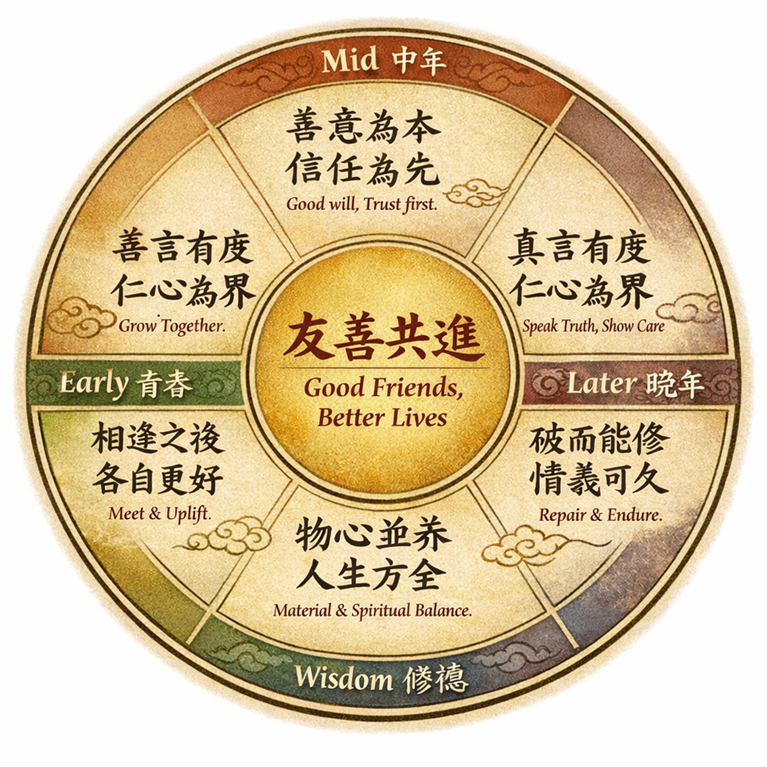
Here are 7 short maxims, each exactly 8 Chinese characters, written in a classical, culture-neutral style, with clear English meanings. These are meant to be remembered, agreed upon, and lived with.

善意為本,信任為先
Good will as the foundation; trust comes first.

真言有度,仁心為界
Speak truth with measure; let compassion set the boundary.

同進不踩,共成其美
Advance together without stepping on one another; succeed beautifully as one.

和而不同,敬守其尊
Harmony without sameness; dignity always respected.

物心並養,人生方全
Material life and inner life nourished together; only then is life whole.6.

破而能修,情義可久

相逢之後,各自更好
After meeting, each goes away better.

Image created • Friendship wisdom wheel

Generated image

Feel Proud if you have something really Worth Being Proud of. Maybe feeling Grateful is the Right Feeling? Don’t get carried away after you did something quite Spectacular. Be modest, grateful and not Proud, Arrogant, or Conceited. How can we best practice this ? How would you first define “Quite Spectacular”? – Billy – January 2026

ChatGPT :  You are circling a quiet moral discipline                                                                                                                  

How to stand upright without standing above others.

Let me answer in two movements:
first, what “quite spectacular” really is;
then, how one practices gratitude instead of pride.


1. What is “quite spectacular”?

Something is quite spectacular when:

Its impact clearly exceeds your intention, your effort, and your entitlement.

More precisely, a deed becomes “spectacular” when at least three of these are true:

  1. It benefits others substantially, not just yourself
    (relief, dignity, opportunity, healing, inspiration).
  2. It could easily have failed, yet did not
    (timing, luck, grace, or unseen help mattered).
  3. It required more than skill
    — character, restraint, patience, courage, or mercy.
  4. Others could not have predicted it from your résumé alone
    (it wasn’t simply “what someone like you usually does”).
  5. You are not the sole author
    — teachers, ancestors, collaborators, culture, circumstance all played a role.

When something is truly spectacular, the ego actually feels smaller, not larger, because you see how much had to align beyond you.


2. Why gratitude is the right feeling

Pride says:

“This proves who I am.”

Gratitude says:

“This reminds me what was given to me.”

Gratitude is more accurate.

Because every meaningful act stands on:

  • bodies you did not design
  • languages you did not invent
  • values you inherited
  • people who trusted you
  • moments you did not control

To feel only pride is to misread causality.

Gratitude acknowledges the full picture.


3. How do we practice this?

The Source Audit

After doing something remarkable, quietly ask:

“What five things made this possible that were not me?”

Name them concretely:

  • a person
  • a prior failure
  • a moment of restraint
  • a cultural inheritance
  • sheer timing

This dissolves arrogance without diminishing excellence.

______________________________________________________________________________

Here is a single-paragraph calligraphic scroll, balanced, quiet, and suitable for display.
(English followed by Chinese, each as one continuous paragraph.)

English

When an outcome appears spectacular, pause and give thanks before claiming credit, for every good result rests on unseen hands, borrowed time, shared trust, and favorable moments not of our making; pride seeks to possess success, but gratitude understands its true source, allowing us to remain steady, modest, and free to continue doing the next good thing in silence.

中文

当成果看似卓越时,当先停步而感恩,而非急于归功于己;因为一切善果,皆立于无数无形之手、借来的时机、彼此的信任,与非我所能掌控的因缘之上;骄傲欲占有成功,感恩却洞察其本源,使人心志平稳、谦和自持,得以安静地继续行善。


ChatGPT:  I can refine this further toward classical Chinese, or adjust the rhythm and spacing for a vertical hanging scroll.

English (Refined Calligraphic Style)

When an outcome appears truly remarkable, pause and give thanks before taking credit, for every good result rests upon unseen hands, borrowed time, shared trust, and fortunate alignments beyond our making; pride seeks possession, but gratitude perceives origin, keeping the heart steady, the spirit modest, and the path open for the next quiet act of good.

中文(文雅凝练版,适合书法

当成果看似卓然不凡,当先止步而致感恩;盖一切善果,皆托于无形之手、借来之时、彼此之信,及非我所能主宰之因缘;骄者欲据其功,感恩者明其所自,使心志安定、德行内敛,得以悄然续行下一善事


A Four-Line Seal-Style Version(篆刻式四行短文)

中文(四行)

卓而不居
成而知源
功不自据
善行无声

English
Be remarkable without possession.
Succeed while knowing the source.
Claim not the merit as your own.
Let good acts remain soundless.


Besides my Bed and my Computer Desk, the most Meaningful Furniture for me personally are The Dining Table and Living Room Sofa, for There I have my Meaningful Life – my Social Existence. Please help me explain why. Sharing food together and Conversing civilly or intimately allows me to enjoy comfort and worthiness. Billy – January 2026

ChatGPT: This fits beautifully with how you think about friendship, warmth, and human connection. I’ll try to explain it in a way that honors both the everyday and the deeply human.


Beyond the bed (where life is restored) and the desk (where thought is exercised),
the dining table and the living-room sofa are where life is shared.

1. Why the Dining Table Matters

The dining table is where survival becomes meaning.

  • Food is a biological necessity, but eating together transforms nourishment into relationship.
  • Sharing a meal lowers defenses: hands are occupied, time slows, roles soften.
  • At the table, people become equals in hunger, regardless of status or achievement.

When you share food:

  • You are saying “You may depend on me, and I on you.”
  • You experience worthiness because you are not consuming alone—you are invited and received.
  • Civility is practiced here: waiting, offering, listening, blessing the moment—these are quiet moral acts.

Across cultures, the table has always been a social altar.


2. Why the Living Room Sofa Matters

If the table is about sharing sustenance, the sofa is about sharing presence.

  • Sitting side by side (not face to face across a barrier) allows intimacy without pressure.
  • The sofa holds conversations that don’t need to “go anywhere.”
  • Silence is allowed. Digressions are welcome. Emotions can arrive unannounced.

On the sofa:

  • People reveal stories rather than positions.
  • Civility can soften into tenderness.
  • You feel comfort because you are not performing.
  • You feel worthy because your presence alone is sufficient.

It is where friendship breathes.


3. Social Existence vs. Functional Existence

Your bed supports your body.
Your desk supports your mind.
But the table and the sofa support your belonging.

They are the furniture of:

  • Mutual recognition
  • Emotional warmth
  • Shared time (the rarest gift)
  • Being seen without being evaluated

This is why losing friends can feel like losing body heat—because these spaces depend on living mirrors.


1. Short Reflective Reading

Where My Social Life Lives

English

Beyond my bed, where my body rests,
and beyond my desk, where my mind works,
my true social life unfolds
at the dining table and on the living-room sofa.

At the table, sharing food turns survival into meaning.
I am nourished not only by what I eat,
but by being welcomed, listened to, and regarded as worthy.

On the sofa, shared presence needs no performance.
Conversation, silence, laughter, and vulnerability
weave comfort and trust.

Here, warmth returns to my body,
and my life remembers
that to be human
is to belong.


中文(简体

除了让我身体安歇的床,
除了让我思想运转的书桌,
我的社会生命
真正栖居在餐桌与客厅的沙发上

在餐桌旁,
共食让生存升华为意义。
我被滋养的,
不只是食物,
更是被接纳、被倾听、被珍视

在沙发上,
陪伴无需表演。
谈、沉默、笑声与脆弱
编织出安慰与信任

正是在这里,
温暖回到我的身体,
我的生命记起——
做一个人,
就是有所归属

______________________________________________________________________